Champion of Change
Two Young Women are Changing the Conversation for Girls in Somaliland
In Awdal region, Somaliland, two young women are having the kind of conversations most people prefer to avoid. Hibak Barkhad Jama and Rahma Ismail sit with relatives, neighbours and parents to talk about female genital mutilation (FGM/C) and child marriage, practices that have shaped what is expected of girls in their communities for generations.
The theme of this year’s International Youth Day, Different Contexts, Common Aspirations, resonates with Hibak and Rahma. In Somalia, FGM/C prevalence stands at 99.6 per cent, among the highest recorded anywhere, and most girls undergo the most severe form of cutting. That is the context. The aspiration is ordinary. The girls they sit with want to be safe, to stay in school, and to have a say in their own lives. What is changing is who does the asking, because the people now leading these conversations are young people from the communities themselves.
That is the thinking behind Champions of Change. Future4Binti does not send outsiders in to deliver messages about FGM/C and child marriage. It equips people who already live in these communities and already carry standing there: young people, parents, teachers, religious leaders and elders, anyone with enough local influence to make others think again. Facilitators are drawn from local partner organisations rooted in the same districts, then trained to deliver the Champions of Change curriculum with adolescent girls and boys as a structured series of sessions rather than a one-off awareness event.
Both work under Future4Binti (F4B), a five-year regional programme to end FGM/C and child, early and forced marriage across Kenya, Ethiopia and Somalia.

For Hibak, the decision to become a Champion of Change came from a conviction that lasting change begins with people willing to challenge harmful norms and lead by example. She wanted to sharpen her knowledge and skills so she could advocate more effectively for gender equality and youth empowerment. She is clear that the role is not a training certificate but a responsibility. One that asks her to use her voice and work alongside her community so that girls and young women have equal opportunity to thrive. Small actions, taken consistently, are what she believes will move things.
Rahma’s reasoning is more direct. She became a Champion of Change because she wanted to make a positive difference in her community, and because she believes every girl deserves to grow up safe, healthy, educated and free from FGM/C and child marriage.
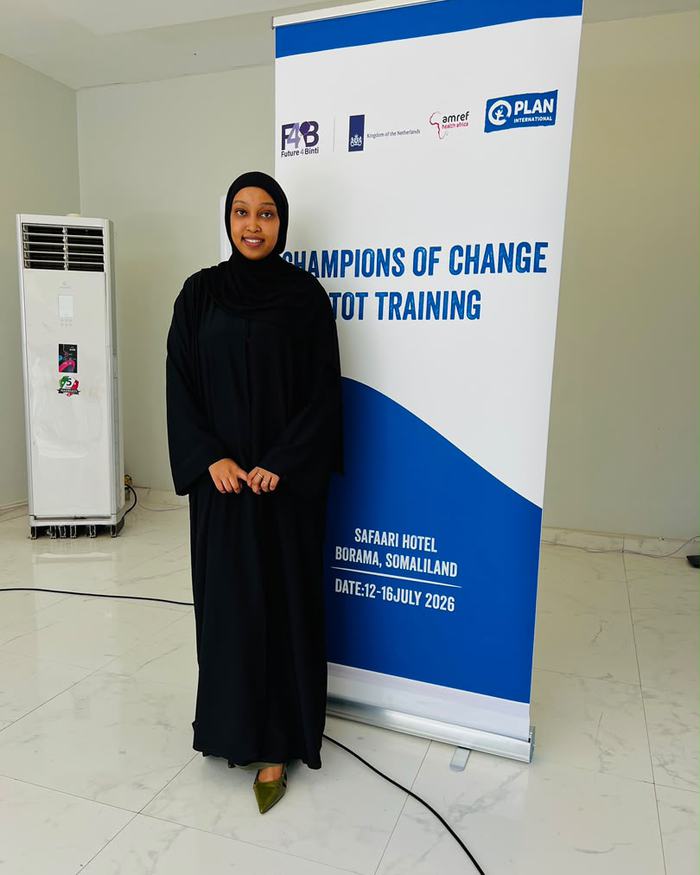
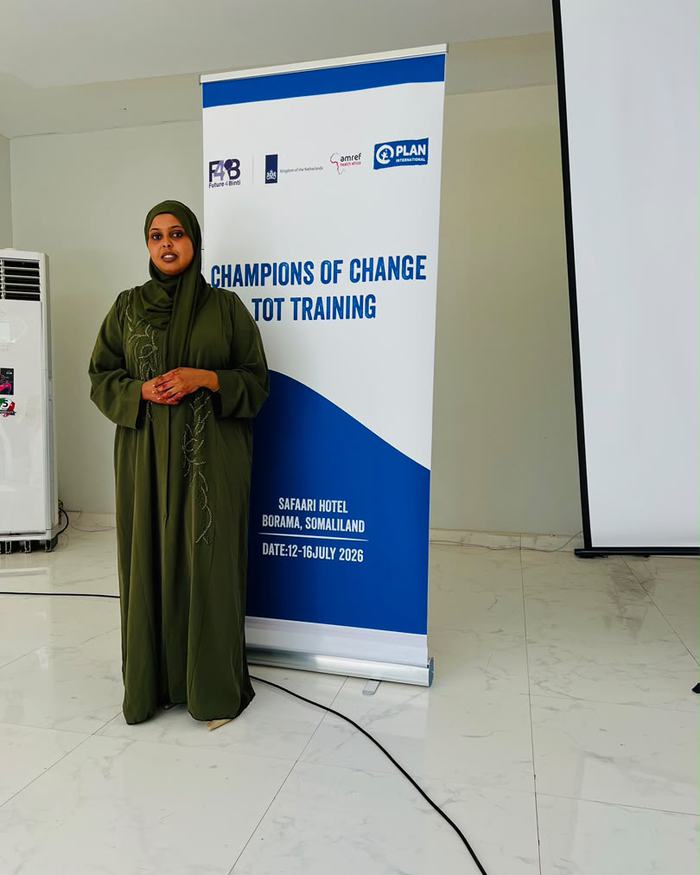
Conviction was where they both started. The skills came in July 2026, when they were among ten people who spent five days in Borama learning to deliver the Champions of Change curriculum, a training run by Plan International, drawing facilitators from local partners Ubah Inspire Initiative and Somali Women Resource Center (SWRC). The week covered gender equality, positive masculinities, harmful social norms, the prevention of FGM/C and child marriage, and safeguarding. Much of it was spent rehearsing: role plays, simulations and practice facilitation sessions, so that the first time they held one of these conversations for real, it would not be the first time they had held it at all. Eight facilitators finished the week certified, four women and four men, with plans in hand to take the curriculum into ten communities.
Both of them can point to moments where the work landed.
Hibak remembers a conversation with a relative who believed that marrying girls early was the surest way to protect them and secure their future. She did not argue. Instead, she shared what she had learned about the value of education, the health risks of early pregnancy, and how delaying marriage opens doors that early marriage closes. By the end of the conversation, her relative had not changed position entirely, but admitted to never having considered those consequences before. They said they would think more carefully before supporting an early marriage and would encourage the girls in the family to finish their education first. Hibak describes this as planting a seed. Real change, in her experience, rarely arrives in a single sitting. It begins when someone starts to question a belief they had never examined.
“Your dreams and voice matter, even if things feel difficult right now. I encourage you not to lose hope, to continue your education, and to seek support from trusted family members, teachers, or community leaders.”
Hibak Barkhad Jama
For Rahma, the moment came after an awareness session, when a family decided not to marry off their daughters. They had understood what education could mean for their girls and what was at stake in protecting their future. She describes the decision as the thing that gave her hope that change is possible.
This is why the programme is built around conversation rather than campaign. Social norms hold because of what people believe their neighbours expect of them, which is why they rarely shift on the strength of a poster or a law alone. They shift when someone with standing says out loud that the expectation has changed, and others hear it said. Equipping trusted local people to lead those conversations, repeatedly and in the open, sits at the centre of Future4Binti’s theory of change.
Neither of them says the work is easy. Hibak says the hardest part is that social norms move slowly, because many people have grown up understanding FGM/C and child marriage as ordinary, and one conversation does not undo that. Rahma names the same obstacle: long-held beliefs and traditions do not yield quickly. What sustains them is what they have already seen. Hibak holds on to the belief that every conversation counts and that small shifts in awareness accumulate into larger ones. Rahma is kept going by watching attitudes change in front of her, and by knowing that she is helping to protect girls’ rights.
“Believe in yourself. Do not give up on your dreams. You have a right to education, to safety, and to a future you choose. With confidence, determination and support, you can reach what you are aiming for.”
Rahma Ismail

The conversations are one part of a wider effort. In Somaliland, Future4Binti has worked with the Ministry of Labour, Social Affairs and Family to disseminate the national Anti-FGM Policy through consultations bringing together parliamentarians, local authorities, religious leaders, traditional elders and youth representatives. In June 2026, the programme convened a cross-border meeting in Jigjiga with counterparts from the Somali Regional State of Ethiopia, because families sometimes cross the border to avoid enforcement. In Galmudug, where an Anti-FGM Law is now in force, government-led awareness campaigns have run across eight districts, and thirty former practitioners and traditional birth attendants have taken part in a workshop on leaving the practice behind.
Which brings it back to Hibak and Rahma. Ten communities are about to work through the Champions of Change curriculum for the first time, and the two of them will be in the room for it. Every session is another opening: a family that thinks again, a girl who stays in school, a daughter who is not cut. On International Youth Day, that is worth saying plainly. They are not waiting to be protected. They are doing the protecting.
Future4Binti is funded by the Embassy of the Kingdom of the Netherlands and implemented by Amref Health Africa, Plan International, Equality Now and more than 20 local civil society organisations in Kenya, Ethiopia and Somalia. The programme works to end female genital mutilation/cutting (FGM/C) and child, early and forced marriage (CEFM) by empowering girls and communities, strengthening services, and advancing policy change.
Author: David Mitine, Communications Manager, Future4Binti