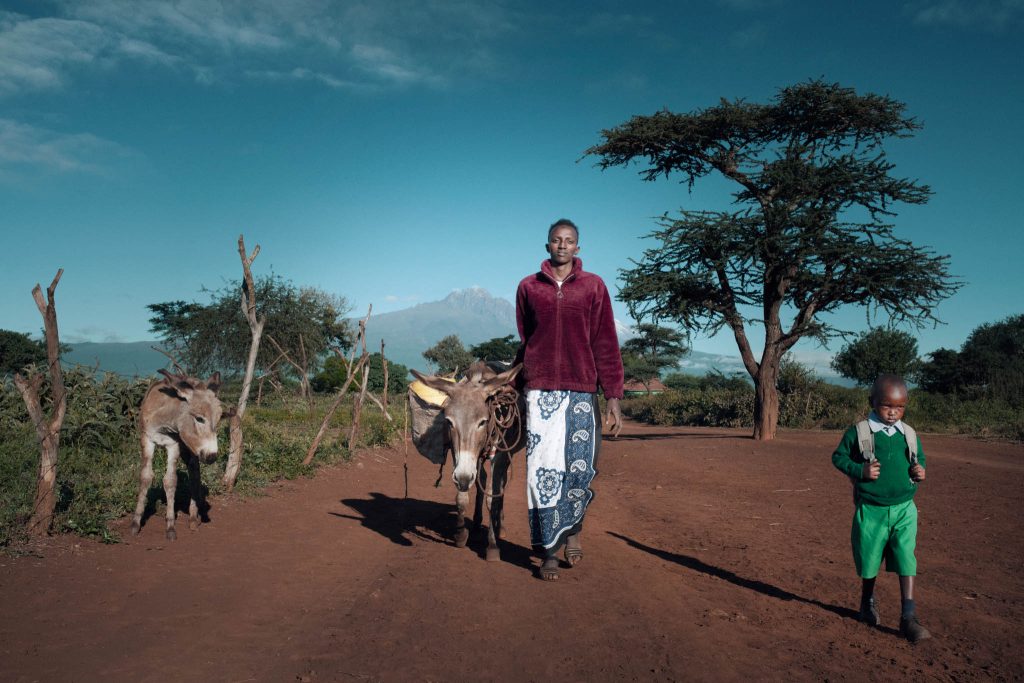
Every three seconds, somewhere in the world, a girl under the age of eighteen is married off. In Kenya, the practice is illegal, yet it happens every day and perpetrators go unpunished. Laws collide with poverty, gender inequality and tradition.
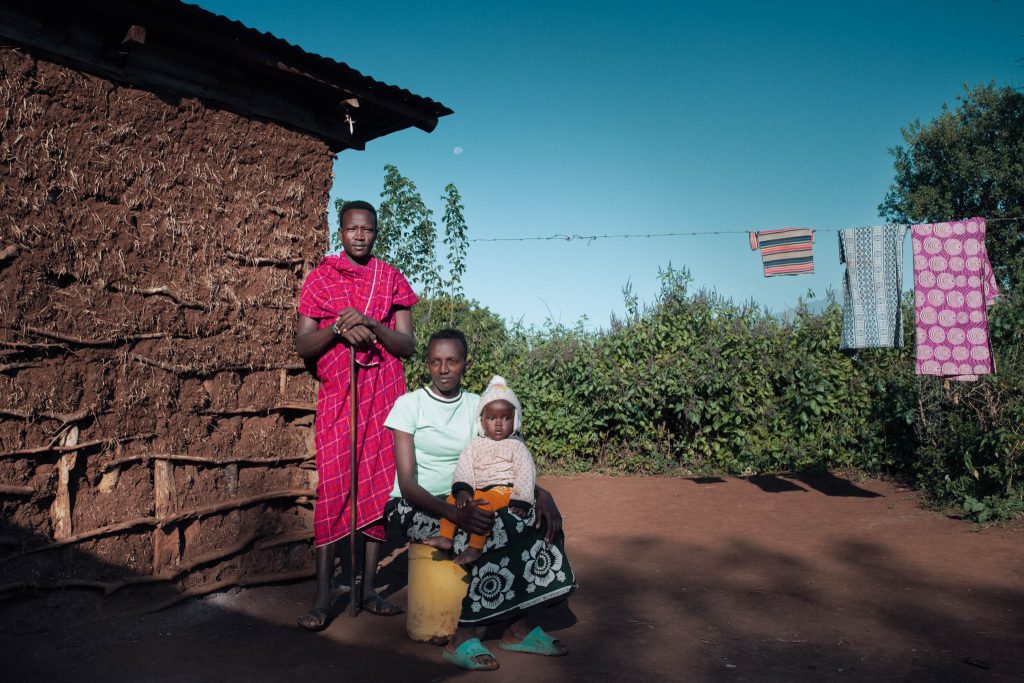
“I was married off by my brother when I was seventeen. It felt as though my life no longer belonged to me.” Esther Solonka (19) stands in the doorway of her mother’s mud house in Rombo, near the border with Tanzania. Brightly coloured laundry flutters on the line. Behind it, Kilimanjaro’s snow-capped summit towers over everything. “Two men on a motorbike came to collect me. My heart sank when I caught their eyes. One of them was Lekin, a 45-year-old man. I had never seen him or spoken to him before.” Her voice softens as her eldest son, Jaden (almost two), squeezes past her and out of the house. He runs into the boma’s courtyard, picks up a ball and starts playing. “From that moment on, I was his wife. On the motorbike, wedged between the driver and my husband, I cried. The whole way. Nobody said anything. My husband did not speak to me until two days later.”
For hundreds of thousands of girls in Kenya, childhood ends not with adolescence but with a forced marriage. According to recent UNICEF figures, around one in four Kenyan girls marries before her eighteenth birthday. In some regions, particularly remote areas, the proportion is considerably higher.
Worldwide, roughly every three seconds a girl under eighteen is married off; every seven seconds, it is a girl under fifteen. That amounts to almost 30,000 child marriages a day, or more than ten million girls a year. Several international human rights organisations warn that this number could rise dramatically in the coming years because of growing inequality, increasing wars and internal conflicts, and the effects of climate change.
Kenya officially has several laws setting the minimum age of marriage at eighteen. “Child marriage has been prohibited since 1990, the year our country ratified the UN Convention on the Rights of the Child,” human rights lawyer Isaac Kuloba explains over the phone from Nairobi. “That international treaty obliges states to protect children against various forms of abuse, including child marriage.” In subsequent years, the prohibition was strengthened in national legislation. The Children Act 2001, for instance, banned “early marriage”, but did not define the term by age, leaving room for interpretation. The Sexual Offences Act of 2006 explicitly criminalised sexual abuse of people under eighteen.
With the adoption of the Children Act 2022, child marriage was finally clearly defined and prohibited—and therefore made a criminal offence. “The law exists on paper, but in practice child marriages often take place out of sight of the authorities,” says Kuloba. “They go unregistered or gain informal legitimacy through local leaders and family agreements.” Legally, parents and guardians are responsible and can face criminal prosecution, but this rarely happens. “Cultural pressure, corruption and a lack of willing witnesses make it difficult to bring perpetrators to justice,” Kuloba says. “Without structural change, the cycle of impunity will continue.”
“When I was sixteen, I became pregnant by a boy I was in love with. When he denied that the baby was his, my world fell apart.” With her son Ryan (nine months) in a sling, Esther walks towards the enclosure where the goats and cows are kept. She opens the gate and the goats rush out, bleating loudly. “I would bring shame on my family. Afraid of being married off, I ran away.” She taps the cows on their hindquarters with a stick and guides them out of the boma too. “A few villages away, I found work as a domestic helper. But when I was more than eight months pregnant, I could no longer manage physically. I saw no other option but to go home. Two days later, my brother had arranged the marriage and my husband came to collect me.”
Child marriage almost always results from a combination of economic pressure, social norms and gender inequality. Poverty plays a central role. In many communities, bridewealth is a crucial source of income, and marrying off a daughter means one less mouth to feed. Climate change intensifies the pressure. Particularly in northern and eastern Kenya, prolonged droughts cause crop failures and livestock deaths, further undermining livelihoods.
In times of scarcity, girls are often the first to be taken out of school—to fetch water, frequently walking many kilometres each day, to collect firewood, to look after livestock or to be married off. During the coronavirus pandemic, poverty increased and schools remained closed for long periods, leading to a rise in the number of girls married off.
Underlying all these factors is persistent structural inequality between men and women. Many rural communities, including the Maasai community to which Esther belongs, are strongly patriarchal. Boys are seen as future breadwinners and decision-makers; girls are expected primarily to marry and have children. Although Kenya officially provides free public education, the costs of transport, school uniforms, books and even pencils are insurmountable obstacles for many families. What may seem economically rational has far-reaching consequences: without education—and the knowledge needed to say no to child marriage—girls have fewer opportunities to become financially independent and therefore fewer prospects for the future.
Child marriage almost invariably means the end of a girl’s education and an abrupt separation from her familiar surroundings. There are also health risks, particularly during pregnancy and childbirth, and a greater risk of domestic violence. Someone without an income of her own or a completed education, and who has become socially isolated from her family, has very few means of returning or seeking protection.
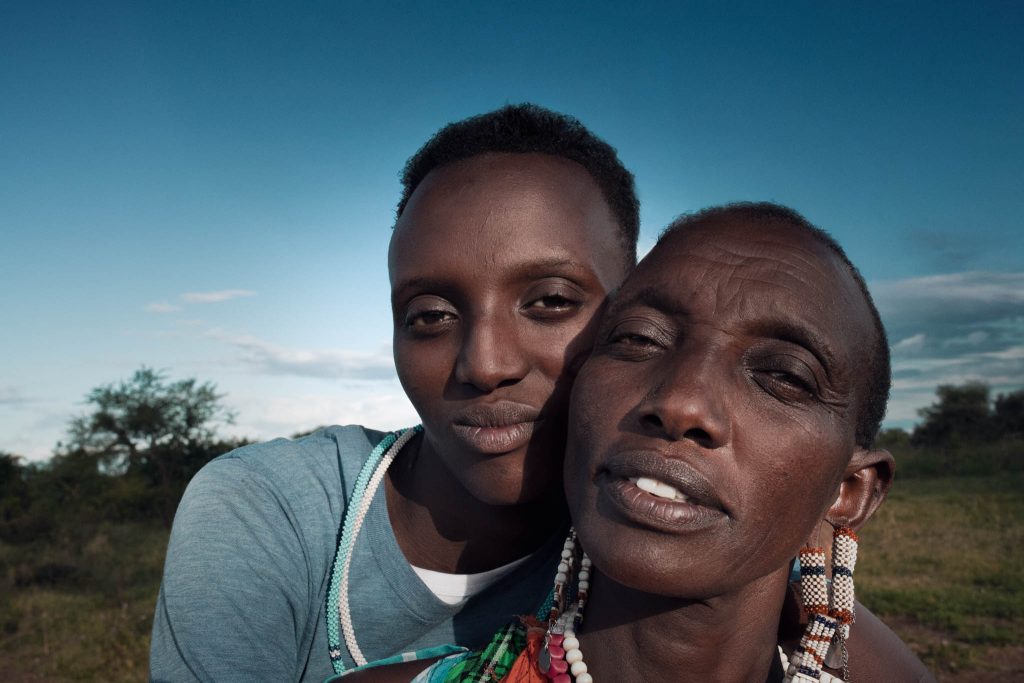
“In the first days after giving birth, my husband’s first wife looked after me. Not long afterwards, the abuse began. My husband was often drunk and forced me to have sex. If I refused, he beat me until I gave in.” Esther looks at Ryan, who is dozing against her shoulder, his eyes half closed. She adjusts the sling and pulls him a little higher. “At night in bed, I prayed, hoping he would not come. But he almost never slept with his first wife. Every night he came to me and raped me.” She sighs. “Four months after giving birth, I was pregnant again.”
To understand why child marriage persists despite the law, it is necessary to recognise how deeply social structures and cultural norms are embedded in Kenya’s pastoralist societies. Elders—respected older men—are regarded as guardians of culture. They make important decisions according to unwritten rules passed down through generations.
One of the elders in Esther’s community is Daudi Kipelan (35). He arrives at the boma on an old motorbike. “Several things are important in our culture,” he says. “Living peacefully, sharing, how we dress, but also birth, death and marriage. Traditionally, marriage is not merely a union between two people; it is also an agreement between families, with economic and social implications.” Yet he sees that the culture is slowly changing. “Education and the internet bring new ideas and perspectives.”
One tradition increasingly being questioned is female circumcision, also known as female genital mutilation (FGM). In Maasai culture, this ritual symbolises the transition from girlhood to womanhood and is often a prerequisite for marriage. Female genital mutilation has been illegal in Kenya since 2011, but enforcement remains limited. Many procedures take place in secret, and corruption among police officers and local leaders also plays a part. “The law was devised in Nairobi,” Kipelan sighs. “Without consulting rural communities or understanding how things work there. If they had involved communities, especially elders who speak out against the practice, much more could have been achieved.”
He leans back and folds his arms across his chest. There is a moment of silence. “In Kenya, people do not speak out openly against FGM. Not the president, not governors,” he says. “I began to think differently after seeing videos and photographs of the procedures. It is too cruel and too painful. We need alternative ways of celebrating a girl’s transition to womanhood.” Some elders, however, continue to uphold the tradition. “I think we need to break the taboo and talk about it openly. Only by talking to one another can we bring about real change.”
“I was thirteen and the last girl in my class who had not been cut. My classmates called me entito, an uncircumcised girl, and said I would never be able to marry unless I went through with it. Eventually, I gave in to the pressure.” Esther sits down on a log and watches the cows grazing peacefully. “The pain was unbearable. There is no anaesthetic, nothing. My mother held me down while the cutter used a razor blade. I cried and screamed. I bled heavily too. For a month, I could barely walk.” Ryan has woken up, and as she breastfeeds him she continues. “If I had known what it really involved, how much it hurts, how much blood there is, I would never have agreed to it. It serves no purpose. It is mutilation.”
Nasha Nudupoi (62) performs female genital cutting and was among those who cut Esther. After much hesitation, she has agreed to an interview. “I learned the trade from my grandmother when I was sixteen,” she says. “At first I held the girls down and tried to comfort them. Later my grandmother let me perform the cutting too. How many girls have I cut? I don’t know, but certainly a hundred.”
Nasha receives around 3,000 Kenyan shillings (twenty euros) for each procedure, a substantial sum in this community. “It is my profession. I make my living from it,” she says. But she feels trapped between two worlds: the tradition she learned from her grandmother and changes coming from outside. At the same time, the law explicitly prohibits her work and imposes severe penalties on offenders. “You cannot just change our culture. It is stronger than the law. Besides, a chief can be bribed to keep quiet. And the cutting remains a secret between me, the girl and her mother.”
Still, she lives with the constant fear that someone will report her to the police. Even her own daughters threaten to do so—a sign of changing attitudes among the younger generation. One memory continues to haunt her: a girl who bled to death during the procedure. “For a year I could not work because of it. That girl’s screams, and those of all the other girls, will stay in my head forever.” The law, her daughters: sometimes she does want to stop. But the money is tempting, and there is always another girl to be cut. “I am simply not strong enough to say no. And if I don’t do it, they will go to someone else.”
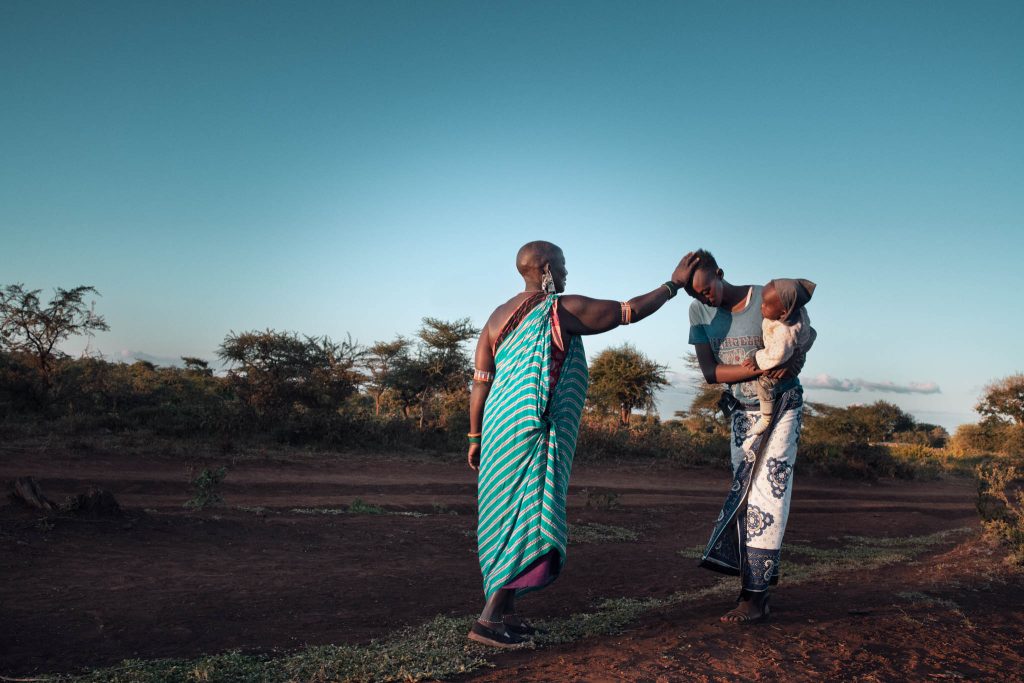
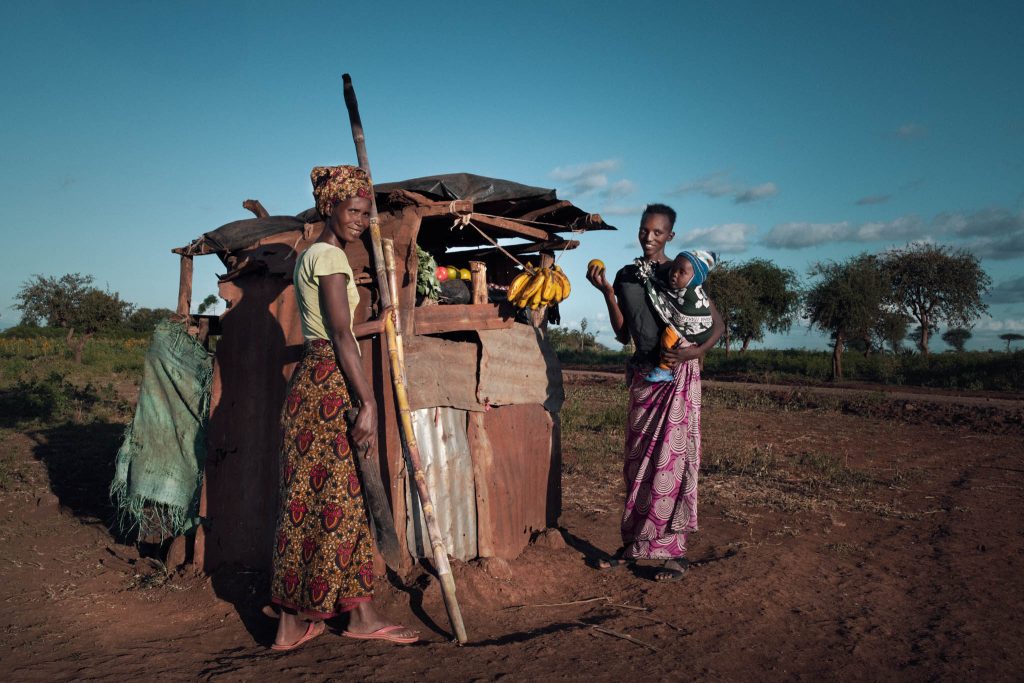
“After the birth of my second son, I was exhausted, mentally and physically. I wanted to escape, but how? I had a two-month-old baby and a one-year-old toddler. My family lived more than fifty kilometres away. Walking was not an option, and I had no motorbike. And the bush is full of lions, elephants and hyenas. I did not dare ask anyone in the village for help either, for fear they would betray me.” Absent-mindedly, Esther gently strokes her baby’s arm. “One day, the mobile clinic came to the village. I told my husband I needed medicine. He let me go, but I took my children with me.” She looks at Ryan and pulls him closer. “At the clinic, I asked a staff member whether I could get a lift into town to buy medicine. From there, I took the bus home. That was seven months ago.”
Esther’s escape is courageous, but also exceptional. Not because girls do not want to escape, but because they rarely can. And even when they succeed, freedom is often temporary. In many cases, a girl is taken back by her family or married off again because she has brought shame on the family—through broken promises and lost honour. In communities where reputation is everything, that shame carries more weight than the girl’s suffering. Escaping also means the loss of livestock. In Maasai culture, bridewealth is rarely paid all at once: two cows are handed over at the wedding, and the rest—up to six more cows—follow later, when the girl stays and bears children.
Esther owes the fact that she was not married off again to her brother, Joshua Solonka (27). “I arranged her marriage out of anger at the time,” he says. “I paid for her schooling, her clothes, her food. Everything. When she became pregnant, I felt she had thrown away her opportunities.” Opportunities he himself never had, because at the age of seven he had to assume the role of man of the house and leave school.
Joshua sits in the same courtyard where the men on the motorbike arrived almost two years earlier. He now acknowledges that his anger was irrational. It was a mixture of disappointment, wounded pride and the unspoken pressure from the community to act quickly and conceal the shame. Marrying her off seemed the most obvious solution at the time. But when Esther returned and told him about the abuse, the rapes and the fear she had lived with, Joshua’s perspective broadened. “I accepted that she had fled and gave her back her freedom.” He thinks Esther is very brave to tell her story now. “I hope it will help her and other girls.”
Lucy Sipilon (35), a police officer in Rombo Ward, sends a WhatsApp message saying she is on her way. Not long afterwards she arrives on foot and apologises for being so late: a girl had come to the police station and needed her help first. “She had fled the violence and rapes inflicted by her husband. She is only fifteen.” Sipilon has worked in Rombo, where she originally comes from, for ten years. “I am the only female officer in the wider area. Girls are more willing to tell me their stories than my male colleagues.” Today’s girl is already the second in a week to have escaped from a child marriage.
Although the number of girls escaping is growing, the number of formal complaints is not increasing at the same rate. “Some girls are too afraid,” says Sipilon. “It is also difficult to report your own father, even if he married you off and turned your life into hell. And they fear reprisals from their father, brother or community.” When girls do report a crime, a lengthy bureaucratic process follows, sometimes taking days. “By the time I can make an arrest, the perpetrator has long since fled. Where to? Everyone keeps their mouths shut. And when he eventually returns, the community remains silent again. Witnesses are scarce and, when there are any, they often withdraw their statements under pressure. Or they are afraid of the police because of the power and authority we have and the punishments we can impose.”
Corruption also plays a role. Chiefs are bribed, and police officers warn perpetrators before an arrest—in exchange for payment. On top of this, the police lack resources. “There are simply too few officers and too few resources to carry out investigations in remote areas,” Sipilon says. “Communities see that there are no consequences. In practice, social loyalty often outweighs the law.”
Her phone rings. She apologises and answers it. “Sorry,” she says a little later. “That was about the girl from this evening. She is staying temporarily at my house. There is no shelter here for girls who have escaped.” Not yet. Sipilon dreams of setting up a shelter herself. “Of course I need money for that, but also the community’s support. For land to build on, for contacts, for information. And above all, to explain why it is needed.”
“My life would have been very different if I had not become pregnant. I could have been studying at university now, like my sister.” Esther looks at her two sons playing together in front of the house. “I now know that you can go back to school after a pregnancy. I hope to finish my education, learn a trade, earn my own income and be independent. That is the future I see for myself.” She laughs as Jaden tries to pick up his little brother and they both tumble to the ground. “Together with my boys. They are my life.”
To end child marriage in the long term, three factors, among others, are essential: changing social norms, educating girls and strengthening families economically. NGOs and social workers play an important role in identifying and preventing child marriage, particularly in remote or nomadic communities where marriages often go unregistered. In practice, lasting change emerges above all when communities themselves are involved in finding solutions. Organisations such as Amref Health Africa therefore place strong emphasis on education and awareness-raising. One initiative is the Future 4 Binti programme; in Swahili, binti means “daughter”, so the name refers to a future for daughters. “Working with local organisations, we organise sessions where girls and boys learn about their rights and how to stand up for them,” says Danny Dubbeldeman, Executive Director of Amref Health Africa in the Netherlands. “The aim is to change both norms and behaviour, not just among young people but within their families and communities too.”
Young women who have experienced child marriage themselves are also taught skills to help them find the confidence to tell their stories and inform and inspire others. At community meetings and on local radio programmes, they speak openly about the consequences of child marriage and female genital mutilation. “By sharing these experiences,” Dubbeldeman explains, “subjects that were taboo for a long time become open for discussion. In this way, change is not imposed but supported from within. That is essential in communities where traditions are deeply rooted.”
Among nomadic groups such as the Maasai, female genital mutilation has for centuries been seen as a rite of passage into adulthood and marriage. The tradition is too complex and too closely bound up with cultural identity, social status and marriage norms to be eliminated simply through legislation. “In consultation with Maasai communities, we developed Alternative Rites of Passage, a symbolic alternative rite of passage without any physical cutting, but with public recognition,” says Dubbeldeman. “This approach is bearing fruit. Girls stay in school longer and are less likely to be married off young. In Kenya and Tanzania, around 22,000 girls have already been spared female genital mutilation and early marriage in this way.” These figures show that change is possible when communities themselves are part of the solution. The sun hangs low over Kilimanjaro. Esther picks up Ryan, takes Jaden by the hand and walks into the house. Tomorrow, life goes on.
By Yvonne Dudock | Photography: Nicole Franken
7 October 2026 | De Groene Amsterdammer, issue 41